
Forming Imagination and Character: St. Bart’s 2026 Musical Theatre Summer Camp
In church life today, many of us have noticed a quiet tension in the formation of children and youth. Our young people are busy–academically driven, highly scheduled, and often remarkably accomplished. And yet, alongside that achievement, we also see anxiety, hesitancy in self-expression, and a diminished capacity for imagination and sustained attention.
As the Church considers how best to nurture the next generation, one answer deserves renewed attention: meaningful exposure to the arts–not solely as entertainment, but as a vital part of Christian formation.
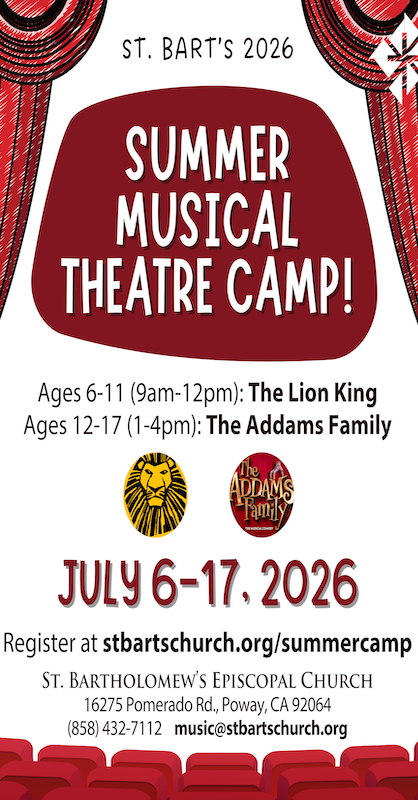 It is precisely this conviction that shapes St. Bart’s 2026 Summer Camp, a two-week Musical Theatre Camp taking place July 6–17, 2026, at St. Bartholomew’s Episcopal Church, Poway (info at stbartschurch.org/summercamp). While the camp culminates in a celebratory showcase of selections from a beloved musical, its deeper purpose is formation: cultivating confidence, creativity, empathy, discipline, and joy within the life of the Church.
Musical Theatre Camp will serve two age groups: children ages 6–11 in a morning session (9:00 a.m.–12:00 p.m.) and youth ages 12–17 in an afternoon session (1:00–4:00 p.m.). Over the course of two weeks, participants will immerse themselves in scene study, vocal work, choreography, character development, and elements of stagecraft, such as props, design, and production.
Musical theatre is uniquely holistic. It engages the whole person. Students must read carefully, memorize faithfully, move intentionally, sing attentively, and collaborate generously. They learn to interpret narrative, understand character motivations, and respond to direction. It is demanding but joyful work.
The Church’s long-standing relationship with the arts is not accidental. From sacred music and stained glass to architecture and poetry, Christian communities have always expressed faith through beauty. This reflects something essential about who we are.
Scripture opens with a God who speaks light into being and delights in the goodness of creation. To say that human beings are made in the image of God is to affirm, among other things, that we are creative by design. When children act, sing, design, and imagine, they are exercising this God-given capacity.
Just like at church, musical theatre rehearsal includes trial and error. Lines are forgotten. Harmonies wobble. Blocking needs adjustment. Yet this is where some of the most important learning happens. Students discover that excellence is rarely immediate; it grows through patience and practice. In a culture that prizes instant results, the slow discipline of rehearsal becomes an unexpected gift.
By the final showcase, what families witness is not simply a performance. They see growth—new confidence, stronger voices, deeper friendships, and the satisfaction that comes from shared effort.
For our youth, portraying a character requires stepping into another person’s perspective—their hopes, struggles, and motivations. That practice forms habits of understanding that extend far beyond the stage. In a divided and impatient world, the ability to inhabit another’s story is a deeply Christian virtue.
The arts also nurture what we might call the moral imagination—the capacity to envision not only the world as it is, but as it might be transformed by grace. Stories shape us. When young people engage them actively rather than passively, they learn to discern meaning, wrestle with complexity, and communicate with nuance. Theatre offers a structured space for expression. Students practice projecting confidence even when nervous. They learn to channel big emotions constructively. They discover how to communicate clearly and publicly. These are transferable skills that serve them in classrooms, churches, and eventually workplaces.
And one of the most powerful aspects of musical theatre is the way it forms community. A production succeeds only when everyone participates faithfully. The lead depends on the ensemble; the ensemble depends on those working behind the scenes. Every role matters. This is a lived image of the Body of Christ. Young people experience firsthand what it means to contribute to something larger than themselves. Success is collective.
That shift is more than educational—it is spiritual. To create something beautiful, even in small measure, is to reflect the Creator. The rehearsal hall becomes a place of participation in that creative calling.
St. Bart’s 2026 Summer Camp is, at one level, a local parish initiative. Yet it also represents something larger: a commitment to holistic formation within the Church. It affirms that imagination, beauty, discipline, and joy belong within our shared life of faith.
As families consider summer opportunities, this camp offers more than two enjoyable weeks. It offers durable virtues–confidence shaped by practice, empathy deepened by storytelling, resilience forged in rehearsal, and friendships built through collaboration.
The arts are not peripheral to Christian life. They are one of its most natural expressions. When we place scripts in young hands, teach them to sing in harmony, and invite them to step into the light of performance, we are doing more than preparing a showcase. We are helping form thoughtful, courageous, creative young Christians.
Find out more about Musical Theatre Camp at stbartschurch.org/summercamp
by
Category: #Communications, #Youth, Children, & Families
Recent Stories
On November 6 and 7, clergy and lay delegates from across the Episcopal Diocese of San Diego will gather at St. Bartholomew’s Episcopal Church in Poway for the 2026 Diocesan […]
Recent news articles indicate that ICE has begun a new surge in San Diego, with increased statewide enforcement expected in the coming weeks. Federal authorities have not publicly confirmed the […]
“Decolores!” This is the greeting Cursillo participants use when they meet. It welcomes others into the family of God with joy, beauty, and a celebration of God’s presence in their […]