
Bishop Susan is calling our diocese to re-commit to courageous love in action. She reminds us, “Our Savior doesn’t make distinctions between people of different countries, backgrounds, or beliefs, but rather invites and commands all of us to grow in love, compassion, and courage.”
To support that call, we’re offering a Peaceful Witness training on Thursday, March 5, at 6 pm. This Courageous Love in Action event will equip participants with practical ways to stay rooted in our Christian faith while engaging in public witness that protects you and your neighbors, especially in moments of tension or conflict.
Whether you plan to participate in public actions or simply want to deepen your understanding of faithful, nonviolent presence, this training is for you.
- Thursday, March 5: Peaceful Wintness Training (Zoom)
Prayerful Presence— Advocacy rooted in prayer and Scripture begins not with anger, but with a desire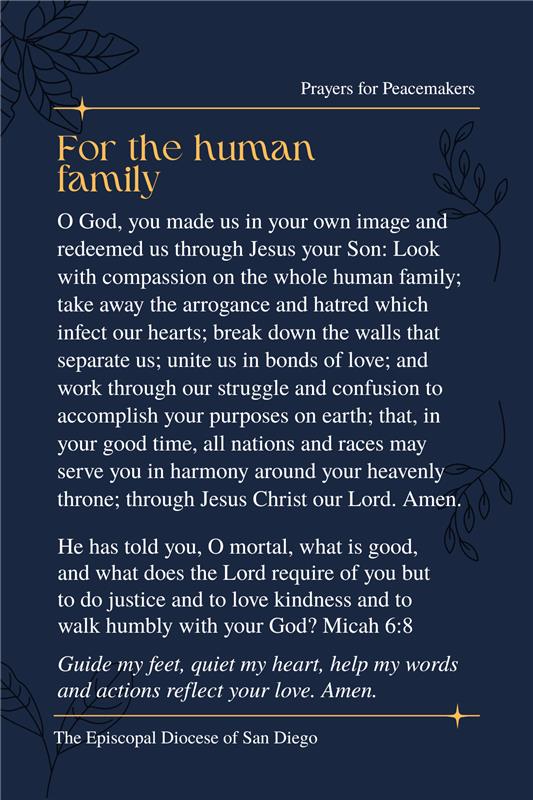 to align our hearts with God’s will. This prayer card (PDF printable template here) is an offering to help you root yourself in God’s call to care for all people. You can find additional prayers and scripture resources here. As you prepare for any courageous act of love, we encourage you to begin and end with prayer, and to allow God’s word to guide you in this important work. If you have questions, please email EDSD Director of Formation, Charlette Preslar, at cpreslar@edsd.org.
Nonviolent Witness
If you choose to participate in faith-rooted public witness, the Episcopal Church has provided a toolkit that offers a broad spectrum of resources. Resources include bystander intervention guidance, de-escalation resources, healthy communication guidance, and safety resources. Whatever happens, follow Jesus, be a peacemaker, love God and your neighbor.
Pastoral Support
You can support our immigrant communities with pastoral care and practical support through the court accompaniment program coordinated by San Diego Organizing Project.
Civic Engagement
Advocate for policies that protect the dignity and rights of all and that seek justice through accountability, transparency, and respect for human life. Through the Episcopal Church’s Office of Government Relations you can sign up for action alerts so that your voice can be heard.
Financial Aid
The Bishop of Minnesota, the Rt. Rev. Craig Loya, has asked for donations to Casa Maria, an Episcopal nonprofit that is organizing groceries and other aid to immigrant families in Minneapolis. You can also visit EDSD’s Migration Ministry page to find ways to support migrants in our region.
Recognizing that our region may see yet another increase in raids, we are again providing information previously shared in diocesan immigration fact sheets. This information is general and does not constitute legal advice.
Make A Plan
Create an action plan, assign leadership to interact with U.S. Immigration and Customs Enforcement (ICE), and designate backups. Establish guidelines and practice procedures for ICE visits. Inform the congregation and understand your rights. Check if your congregation has the legal coverage to defend sanctuary church claims. If not and you believe it would be beneficial, contact EDSD’s CFO, the Rev. Canon Jeff Martinhauk, at jmartinhauk@edsd.org.
Know Your Rights and Understand the Risks
Be clear about the risks of supporting immigrants. Congregations have the right to share legal information with others. You may wish to print Know-Your-Rights cards for distribution in languages spoken in your community. Provide family preparedness plan toolkits and assist congregants in completing caregiver’s authorization affidavit when requested. Keep a record of pro-bono immigration legal aid available in your area. If your congregation is interested in hosting a Know-Your-Rights workshop, please contact Canon Jason Evans at jevans@edsd.org.
Public v. Private Spaces
Church campuses can have both public and private areas. Law enforcement (including ICE) can enter public spaces without a warrant. Worship and outdoor spaces are generally public. Law enforcement (including ICE) may enter private spaces (i) with consent or (ii) with a judge-signed warrant (it will say something like “United States District Court” at the top of the page). Locked areas, including offices, meeting rooms, and restricted areas like the sacristy, are generally private. Marking private areas with signs may help, but signage alone is not definitive. Congregations should consider establishing written policies regarding who has the authority to determine entrance into private areas, and should consider naming such persons on private-space signage (see sample). If your congregation is interested in updating your security systems, please contact EDSD’s Disaster Coordinator, Jeff Green at jgreen@edsd.org.
Confirm Document Accuracy
If ICE does attempt to enforce a deportation order on church property, confirm the officer’s agency, identity, badge number, and reason for the visit. Remind them that this is a sacred place. Ask officers not to disrupt worship. Request a business card. Verify documents to ensure they are judge-signed warrants, not administrative orders. Check names, dates, and locations for accuracy—errors may invalidate a warrant. Request a copy for your records.
Record Interactions
Record interactions by video. Detail who was involved and what was said. You may videotape as long as you don’t interfere with ICE investigations.
Be Respectful, Remain Calm, but Do Not Consent
Clergy should invoke priestly privilege under the First Amendment if asked about an attendee’s immigration status. They may say, “I do not consent,” but should not interfere physically or obstruct officers. You have the right to remain silent. Never provide false or misleading information – it can be a crime to make a false statement to a federal officer.
Respond Quickly
If someone is detained or rights are violated, contact an attorney or legal organization such as Al Otro Lado, Jewish Family Services , or Immigrant Defenders Law Center. When appropriate, assist members in requesting a court hearing change of format. Inform the Bishop’s office immediately by contacting Canon Jason Evans at jevans@edsd.org.