The Real Presence of Holy Week
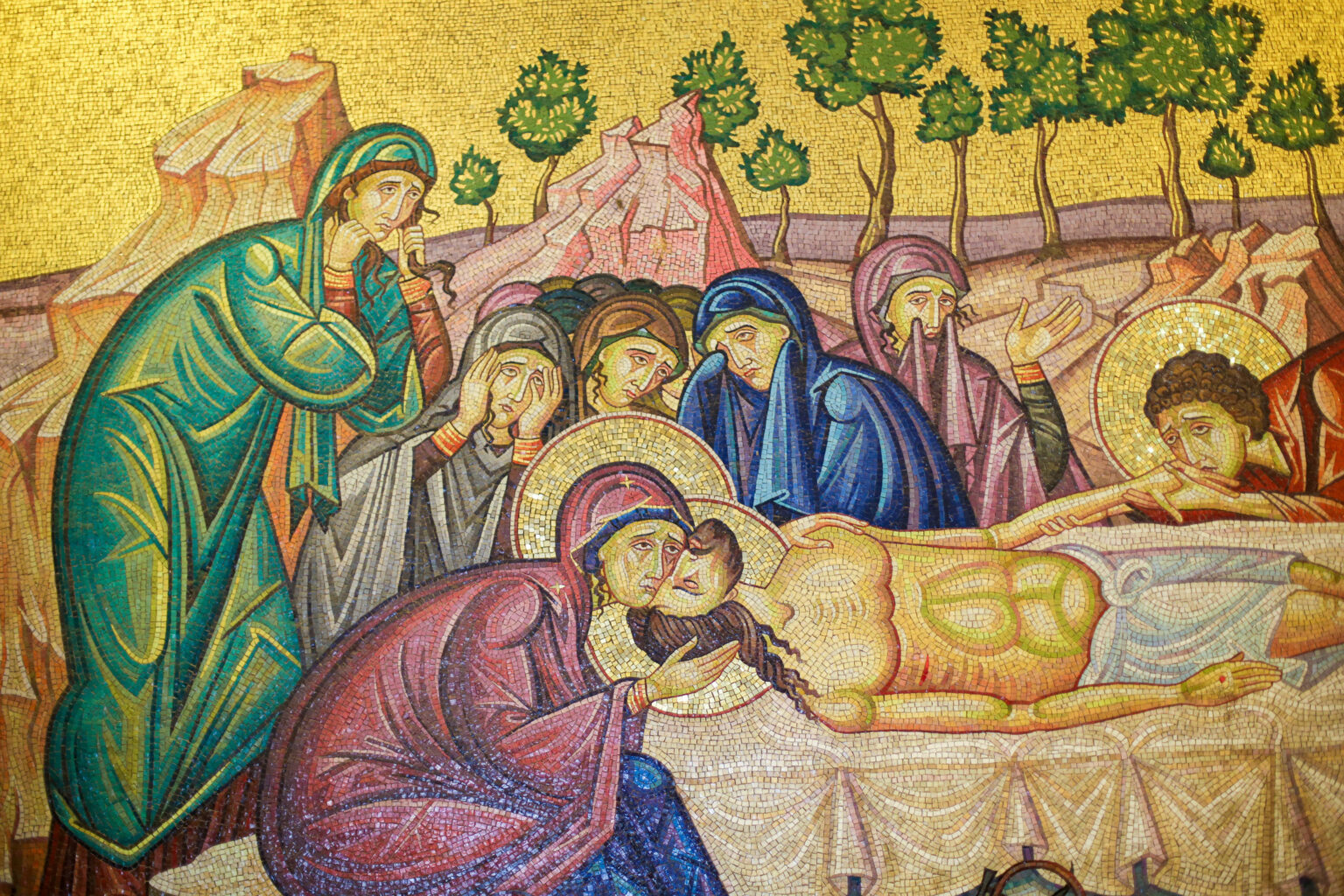
Holy Week is holy not because it is religious but because it is profoundly Real.
My first Holy Week as a new rector challenged me to line up all the necessary things and people for the Palm Sunday procession and dramatic reading of the Passion, the foot washing on Maundy Thursday, the Watch before the Blessed Sacrament on Maundy Thursday night, the Good Friday Liturgy including the Veneration of the Holy Cross, and the Great Vigil of Easter replete with two baptisms of young children. Before the Good Friday liturgy began, a choir member remarked, “You sure are making us come to church an awful lot this week!”
I was taken aback. It somehow hadn’t occurred to me that my enthusiasm for Holy Week didn’t extend to people who saw all those liturgies as a string of services that required a lot of work and a whole lot of churchgoing.
From then on, I had an annual project. Sometime early in Lent, I would begin unpacking what Holy Week was about. I’d send mailings, make announcements, encourage church school teachers to get kids on board, talk it up among parish leaders, write newsletter articles, and develop adult education courses. I guess some of those things might have had a positive effect.
But that project was nothing compared with my eventual discovery that the God we proclaim shows up in our ordinary experience. Holy Week and Easter, like the entirety of Jesus’ life and ministry, are not recollections of historical events, but paths to become aware of those themes and events in our very own experience.
Once, when my older daughter Sarah, was a little over two, she walked in the procession waving a little palm branch on Palm Sunday. I saw in a flash the Great Tradition, each generation grabbing a piece of the holy history and carrying it forward. In that way, we live Holy Week and Easter. The triumphal entry into Jerusalem is as much about you as it is about Jesus. In your life you’ve had your triumphs, perhaps when once you were on stage, applauded for your performance. Or when the air was electric with joy so palpable that even stones seemed to shout out in adulation. Sometimes such moments give way to deep disappointment, sorrow, maybe agony, as you get your own taste of Gethsemane, dreading the cup you know you must drink.
In a New England town, we had a Good Friday children’s liturgy. I would call children from the congregation and have them assume roles in the narratives of each of the stations of the cross. They would form tableaux of the scenes. Once, I called on a little tyke named Andrew to be Simon of Cyrene. I took his hand and helped him take the crude wooden cross from the acolyte, who was acting the part of Jesus. Andrew got scared after a few minutes and started to cry. The acolyte, facing away from him, turned around, bent down to console him, then whispered something in his ear, and once more took the cross, sending the sobbing Andrew back to his mama. That action has come to mean nearly the entirety of the incarnation for me: when we cannot bear what our humanity demands, down down down bends Jesus, taking the cross himself.
In another parish, I went to the day school for my very first Maundy Thursday children’s liturgy. The Director had five volunteers’ feet for me to wash. One backed out. But the remaining four children wanted both their feet washed. I taught them the first verse of that little Ghanaian folk song, “Jesu, Jesu, fill us with your love, show us how to serve the neighbors we have from you.” They squealed with delight, giggling as I poured water over their feet, and probably at the sight of the priest squatting to wash them.
I dried the last foot. The director, holding a little girl’s hand, said, “Father Dunn, Anna has taken off her shoe.” Anna was blind. Normally, when Anna came to chapel, she would often whine and cry. But here she came with her shoe and sock off her right foot, wanting me to wash it. I said, “Wonderful! Anna, we’d love to wash your foot!” The kids cheered and laughed as I poured water over her foot. Anna sucked on her pacifier and smiled. I washed and washed. Someone started singing, “Jesu, Jesu, fill us with your love,…” I could only see Jesus, the rabbi, scrunched down on the floor, washing the feet of his very blind and fearful disciples.
We touch something deep in these liturgies. And that something is the power of Life, of Resurrection, flooding us before we ever even get to “Alleluia” at the Great Vigil of Easter. Palms, foot washing, the Way of the Cross: they thread through human experience, in the lives of a Sarah, an Andrew, an Anna. Although many of my Holy Week anecdotes are about children, Holy Week is anything but a simplistic series of liturgies. They are complex, rich, suggestive.
Yet in my estimation, they are best understood as embodying Jesus’ most radical teaching: “Unless you become as children, you’ll never participate in the Kingdom of God.” Much like a warm hand that touches a knotty muscle, unleashing a flood of memories and sensations, these liturgies touch deep archetypes that flatten us with their power, yet raise us up to new visions of who we are and what we can become: whole, free, open, not unlike the children we were when we began to live.
I encourage you to attend services at your church this Holy Week. The road we travel in preparation for Easter is a holy journey that reveals God in amazing ways.
The Reverend Frank Dunn is a retired priest who lives in Cathedral City and worships at The Church of St. Paul in the Desert, Palm Springs.