Plains Gospel Truth

Carter by Ann

President James Carter

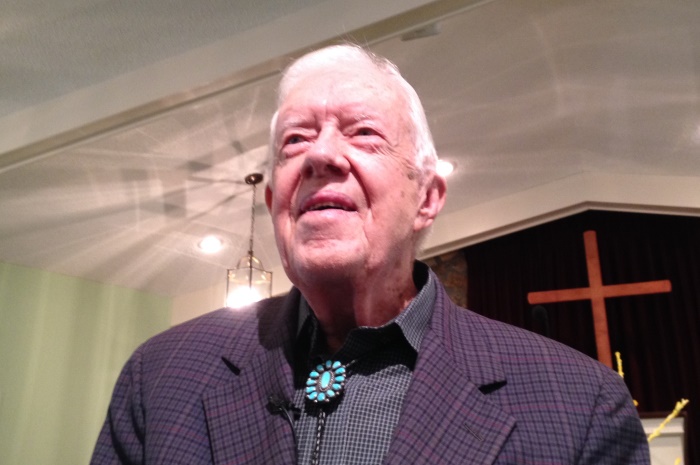
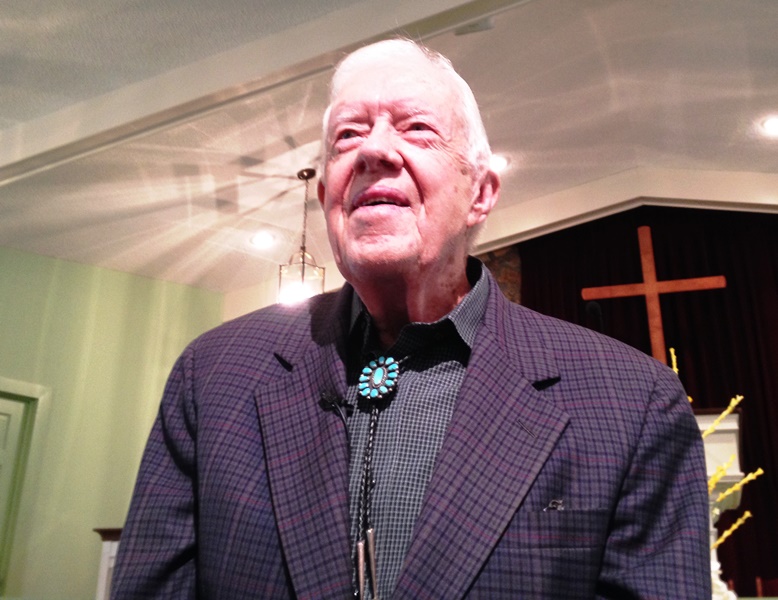
“He is probably the only President to give a Bible study in the White House.  He is the only ex-President to give Bible studies.”  So said Jan, the church volunteer who led the 9:00 am orientation before Jimmy Carter’s Sunday School class on June 5 at Maranatha Baptist Church, Plains, Georgia.  Ann and I arrived at 5:50 am, chatted with other visitors, went through security just before 9:00 am, and sat in the front row beside the only people to arrive before we did.  Just before 10am, President Carter entered.  At 91, his cancer currently undetected, he looked fit.  Smiling and soft-spoken, Mr. Carter greeted all and asked where we were from.  We were from about 25 states from Alaska to Florida, from Massachusetts to California — and from Brazil, India, Kenya, Nepal, Romania, and South Africa.   Next President Carter asked for a show of hands by missionaries and pastors, active or retired.  Prompted, I said: “Episcopal.  California.  Retired.”  He said, smiling broadly, “I’m retired, too.”  Mr. Carter noted that he has been teaching at Emory University for over 30 years before choosing another of the three pastors present, an Emory University professor, to give the opening prayer.

Next President Carter spoke of Carter Institute goals: achieving peace and ending the death penalty.  He asked if any were opposed to Palestinian-Israeli peace.  No one so indicated.  Then he said that he knew many would disagree with him on abolishing the death penalty.  He continued, speaking of the execution process, reporting that, for example, it costs over 33 million dollars per execution in California.  He also spoke of the large number of convictions overturned through DNA testing and the disproportionately high number of black people convicted.

Then President Carter turned to Jesus’ encounter with a Samaritan woman at the well in Sychar (John 4).   Jesus and his disciples were en route from the Judea to Galilee.  He reviewed the origins of the enmity between Samaritans and Jews and noted that most Jews took the long way around to avoid Samaria.  President Carter enumerated the boundaries Jesus crossed at the well: a Jew speaking to a Samaritan and a Jewish man speaking to a woman not a member of his family.  Moreover, he asked her for a drink of water.  Mr. Carter commented on the woman’s rapid grasp of what Jesus meant by “living water” and her becoming the “first evangelist” when she went into town witnessing to Jesus.  Mr. Carter compared the boundaries violations at the well to experiences from his early years in the fields of Plains.  With sadness, he recalled separate water buckets and ladles for black and for white field workers.

Mr. Carter offered a prayer at the conclusion of his class.  Shortly, Mrs. Carter joined him in a side pew for Maranatha members.   Worship began at 11 am.  Pastor Jeremy Shoulta preached insightfully and many fine Baptist hymns were sung.  Following a photo with the Carters, we left after a long and most worthwhile morning.


Rest in Peace Sallye Ann Graves

Graves Sallye

Rest in Peace, Sallye Ann Graves
January 31, 1928 – June 7, 2016

Sallye Ann Graves, loving wife, mom, grandmother and great-grandmother, passed away peacefully on June 7, 2016 in San Diego, California at the age of 88.  Wife of the late Rev. Gerald H. Graves, former Rector of Saint John’s Episcopal Church in Chula Vista, CA, Sallye’s life passions included her love of family and friends, dedication to her church, music and performing arts, and serving as a rescue volunteer for homeless animals.

Born January 31, 1928 in Asheville, North Carolina, Sallye’s musical talents emerged at the early age of 14 through studying piano, singing, and eventually performing with her mother, late vocalist and entertainer Theresa Grimes, on multiple radio outlets from New York City to the Midwest. Sallye graduated from The University of Tulsa, Oklahoma in 1950 with a B.A. in Fine Arts and as a Sister of the Kappa Delta Sorority and member of the Theta Alpha Phi National Honorary Dramatic Fraternity. She returned to New York City, where she performed professionally and was offered a contract to tour with famed bandleader and radio-television personality Fred Waring and his orchestra. She instead accepted the marriage proposal of Gerald Holmes Graves of Tulsa, Oklahoma, eventually relocating to Berkeley, California where her new husband attended Episcopal Seminary, and where they began their new family.

Over the years, Sallye served as a devoted parish wife at her husband’s California Episcopal parishes, including St. Mark’s (Altadena), Church of the Ascension (Tujunga), St. Columba’s (Camarillo), and finally St. John’s (Chula Vista), all the while maintaining a career in music and performing arts. In later years, Sallye and husband Father Jerry traveled to Great Britain on multiple occasions to tour various Anglican and Episcopal churches and cathedrals, and once took part in a parish exchange program with a British priest and his family, giving each other the opportunity to experience the other’s parish for several weeks.

During the 1960s, Sallye trained with Los Angeles voice teacher and mentor Jack Metz, becoming especially active in theater productions throughout Ventura County and landing lead roles in musical theater productions including ‘The Sound of Music’ (a production featuring her husband and all four children in key speaking/singing roles); ‘My Fair Lady’, ‘The Mikado’, ‘Oklahoma’, ‘The Desert Song’, ‘Madame Butterfly’, and ‘Pirates of Penzance’. Upon relocation to the San Diego area in 1970, Sallye joined the San Diego Opera and spent nearly a decade as a featured singer of opera and musical theater at the original Mario’s Restaurant in downtown San Diego. In later years, Sallye continued to perform professionally, while remaining a faithful parishioner and member of Saint John’s Episcopal Church choir in Chula Vista through her final days.

In the 1990s Sallye emerged as a strong advocate for animal rights, working with other animal rights volunteers to persuade city officials to build a new and improved Chula Vista Animal Care Facility and helping to place hundreds of homeless dogs and cats in homes throughout San Diego County.  Two of Sallye’s rescues that she adopted to be her own –Buster Brown and Sami – remain living with her family.

Sallye was preceded in death by her husband The Rev. Gerald H. Graves and son Gerald Lawrence Graves, both in 1987. She is survived by daughters Jane Ferguson of San Diego and Linda Maker of Temecula; son Mark Graves of Chula Vista; grandchildren Michael Erwin, Jennifer Brunner, Jessica Bilandzija, Alissa Atkinson, Ryan Maker, and Larry Ferguson; and great-grandchildren Anna and Robby Brunner, Isaiah Cabral, Diego and Ava Atkinson, and Isabella, Catalina and Julian Bilandzia.

A Memorial Service and Celebration of Life will be held Saturday, June 25, at 11:00 a.m., Saint John’s Episcopal Church, 760 First Avenue, Chula Vista, CA 91910.

The family requests that in lieu of flowers, donations be made in Sallye’s name to the Chula Vista Animal Care Facility, 130 Beyer Way, Chula Vista, CA 91910 (619) 691-5123.

The family is being served by Legacy Funeral and Cremation Care in La Mesa, CA. Memories and on-line condolences may be shared with the family at www.legacyfuneralcare.com.


El Redescubrimiento del espíritu generoso

El Redescubrimiento  del espíritu generoso.
Por el Reverendísimo James R. Mathes.
15 de marzo de 2016.

Durante las últimas semanas nuestra nación se ha enfocado en la inusitada  candidatura de Donald J. Trump. Para algunos, parece ser el líder no oficialista y de lenguaje directo que necesitamos. Otros lo ven como descuidado y agente de división. Lo que parece claro es que su mensaje está en consonancia con un número significativo  de personas. No importa que esté dispuesto a utilizar el racismo para dividir o que explote los temores hacia los extranjeros, convirtiendo a los musulmanes y a los indocumentados en chivos expiatorios apropiados. Resulta  especialmente escalofriante observar cómo excluye sin miramiento a los afroamericanos de sus campañas en las que en los últimos dos días los participantes blancos semejan de forma espectral a los de las concentraciones fascistas de otros tiempos con armas en alto para apoyar a su líder.

Sencillamente supuse que esto terminaría una vez que recobráramos la cordura  y redescubriéramos nuestros principios comunes. Sin embargo, el Sr. Trump no parece retirarse. Y la razón por la que no se retira es porque él no es el problema. Es el síntoma. Lo cierto es que los líderes que escogemos nos reflejan. Muchos de nosotros hemos hecho silencio. Y muchos más nos dejamos convencer de que los otros tienen la culpa de nuestros males y que al disminuir a los demás encontraremos la salvación.

Estas tácticas pudieran ganar elecciones pero no sanarán un mundo quebrantado o mejorarán  una nación. Trump propone engrandecer de nuevo los EE.UU., pero sugiere hacerlo a costa de otros. Desea impedir la entrada de inmigrantes, elevar las tarifas, construir muros y restablecer la tortura. Postula un mundo de deseables e indeseables, y apuesta a que haya un número suficiente de nosotros que nos consideremos entre los  afortunados y votemos en correspondencia.

Lo que resulta particularmente humillante es su afirmación de que es un gran cristiano. Su reciente encontronazo con el Papa católico romano ni siquiera parece afectar su afirmación. Como obispo de la Iglesia, por demasiado tiempo he meneado la cabeza y permanecido en silencio. ¡Basta ya! Como dice el viejo himno: “Conocerán que somos cristianos por nuestro amor”. Ser cristiano es seguir en amor intrépido a Jesús. Ser cristiano es ser el que ofrece ese amor a todos, el que ve a Cristo en los demás, el que muestra la preferencia de Jesús por los pobres, los marginados y los desconocidos. ¿En qué sentido refleja la retórica de división y culpa del Sr. Trump la vía de Jesús? Deberíamos hacerle al Sr. Trump aquella famosa pregunta de Jesús: “¿quién es mi prójimo?” La definición cristiana de prójimo nunca tolerará muros o tortura ni ninguna forma de menosprecio o división.

Mi fe cristiana requiere que rechace lo que expone el Sr. Trump. Sin embargo, este momento constituye una oportunidad para preguntar, como nación, cuáles son nuestros valores esenciales. En las palabras del primer presidente republicano, se nos convida a descubrir “los mejores ángeles de nuestra naturaleza”. Como una nación de inmigrantes que asume cada vez más nuestra compleja historia de racismo, sexismo y homofobia, podemos reclamar una generosidad de espíritu que trascienda nuestras identidades religiosas individuales. Ella comienza el  y termina con la premisa de que somos en realidad  creados en igualdad y como dicen las Escrituras: “a semejanza de Dios”. Todos somos portadores del potencial de lo divino. Todos tenemos que ser respetados. Cada persona es el prójimo de toda otra persona. Las vidas de las personas de la raza negra importan y todas las vidas importan y vamos a hacer algo por todas las vidas. Al final, la unidad es más fuerte que la división; la esperanza es más fuerte que el temor. Y siempre el amor vence el odio. Corresponde a cada uno de nosotros transformar esta campaña política, este país y este mundo. Lo lograremos   por la forma en que tratemos  a los más desvalidos en medio de nosotros. Lo lograremos a través de nuestro voto.

Vencer el  mal con el amor.

Al  pueblo de Dios en la Diócesis Episcopal de San Diego y el Sínodo del Pacífico de la Iglesia Luterana Evangélica en los EE.UU.

“Por lo cual estoy seguro de que ni la muerte,  ni la vida,  ni ángeles,  ni principados,  ni potestades,  ni lo presente,  ni lo por venir, ni lo alto,  ni lo profundo,  ni ninguna otra cosa creada nos podrá separar del amor de Dios,  que es en Cristo Jesús Señor nuestro”. Romanos 8: 38-39.

El martes de la Semana Santa nosotros, los obispos y el clero de la Diócesis Episcopal de San Diego y el Sínodo del Pacífico de la Iglesia Luterana Evangélica en los  EE.UU. nos congregamos  para renovar nuestros votos de ordenación y bendecir los Santos Óleos para usarse en el bautismo y en la unción de los enfermos y moribundos. Comenzamos este día de recordación y renovación bajo la sombra de otro ataque terrorista más. Aunque Bélgica se encuentra a una gran distancia las ondas de conmoción de las infames explosiones reverberan en nuestra comunidad. Ofrecemos nuestras oraciones para que el bálsamo sanador de Dios se derrame sobre los afectados.

Durante la Semana Santa los cristianos recuerdan el fatídico viaje de Jesús a Jerusalén y a la cruz. El terrorismo no es nada nuevo. La cruz romana, como las bombas de Bruselas, se diseñó para crear el terror. La cruz se proponía aterrorizar no solamente a la víctima sino a la sociedad más amplia. La bomba lanzada al azar busca un impacto similar.

La realidad profunda y universalmente transformadora de esta semana es que la cruz romana no tiene la última palabra. Es el amor, y no la fuerza mayor, la que prevalece sobre las fuerzas del mal–aun el terrorismo. Verdaderamente la cruz se transforma de instrumento de ejecución a símbolo del amor de Dios. La muerte y resurrección de Jesús derrotan el poder de la muerte mediante la abundante paciencia y el amor sacrificial de Dios por el mundo. El terrorismo jamás será derrotado por una mayor o mejor seguridad o mediante la fuerza. Antes bien, el terrorismo será vencido por la paciencia y el amor. Este mal perderá todo su poder si nos rehusamos a ser cambiados por los que desean que nos volvamos desconfiados en contra de nuestro prójimo. Nuestra mejor respuesta en el esfuerzo para poner fin al terrorismo es eliminar el poder del terrorista para cambiarnos.

Por tanto, oramos por las víctimas,  los primeros en responder, por aquellos que se esfuerzan por construir un mundo más seguro y por el valor para confiar en el poder del amor de Dios. En este día nosotros, como seguidores de Jesús vamos por el camino a Jerusalén y al Calvario. Rechazamos los principados y los poderes de la violencia.

Aceptamos la cruz. Confiamos en el amor de Dios. Convidamos a otros a seguir a Jesús en este camino.

El Obispo y el clero de la Diócesis Episcopal de San Diego y
El Obispo y el clero del Sínodo del Pacífico de la Iglesia Luterana Evangélica en los EE.UU.
Reunidos en la Catedral de San Pablo, San Diego.

Traducido por el Rvdo. Carlos E. Expósito
Diócesis Anglicana/Episcopal de Cuba


St. Anne’s Community Update

I am prayerful that you, along with Christians throughout the world, found a deeper connection with Christ in prayer and meditation during Holy Week. A solemn period for us to journey with Jesus to the Cross. I will cherish the beautiful and prayerful Healing Evensong the St. Anne’s community held on March 19 inviting those present to a new entrance in life, as we all reflected on Jesus’ entrance into the city of Jerusalem.

We are reminded that we are a resurrection people, we followers of Jesus, and just as Jesus was not intimidated by the cross or the ruthless treatment he received, we are invited to keep our eyes, heart, and mind focused on the love that God has for us and we have for him. Not the worldly things that we are constantly bombarded with. Let us hold in prayer all those impacted by the hurt that goes on all around us and in our world.

May Easter remind us that each day we have the opportunity to rise again and continue to grow into the person God created us to be!

In keeping with our regathering in community, please be reminded that we will be coming together at 4 p.m. on Saturday, April 23 at Buccaneer Park in Oceanside. We will have a Joyful Celebration of Eastertide and Springtime with Evening Prayer and a wealth of Uplifting Praise Music provided by Pete, Kaitlyn and all gathered and hopefully you might invite other musically inclined sisters and brothers from the diocese, friends and neighbors.


Defeating Evil Through Love

A Word to the People of God in the Episcopal Diocese of San Diego and the Pacifica Synod of the Evangelical Lutheran Church in America
Wednesday in Holy Week
March 23, 2016

“For I am convinced that neither death, nor life, nor angels, nor rulers, nor things present, nor things to come, nor powers, nor height, nor depth, nor anything else in all creation, will be able to separate us from the love of God in Christ Jesus our Lord.” – Romans 8:38-39

On Tuesday in Holy Week, we, the bishops and clergy of the Episcopal Diocese of San Diego and the Pacifica Synod of the Evangelical Lutheran Church in America gathered to renew our ordination vows and to bless Holy Oils to be used in baptism and to anoint the sick and dying. We began this day of remembering and renewal under the shadow of yet another terrorist attack. Even though Belgium is a half a world away, the shock waves of infamous explosions reverberate to our community. We offer our prayers that God’s healing balm may be poured upon those affected.

In Holy Week, Christians recall the fateful journey of Jesus to Jerusalem and the cross. Terrorism is nothing new. The Roman cross, like the bombs of Brussels, was designed to create fear. The cross intended to terrorize not just the victim but the wider society. The random bomb seeks a similar impact.

The profound and cosmos-changing reality of this week is that the Roman cross is not the final word. Love, not greater force, prevails over the forces of evil—even terrorism. Indeed, the cross is transformed from a tool of execution into a symbol of God’s love. The death and resurrection of Jesus defeats the power of death by God’s abundant patience and sacrificial love for the world. Terrorism will never be defeated by more and better security or by force. Rather, terrorism will be overcome by patience and by love. This evil will be rendered powerless if we refuse to be changed by those who wish us to distrust and turn on our neighbor. Our greatest response in the effort to end terrorism is to take away the terrorist’s power to change us.

And so, we pray for the victims, the first responders, for those who strive for a safer world, and for courage to trust in the power of God’s love. On this day, we, as followers of Jesus, move down the road to Jerusalem and Calvary. We reject the principalities and powers of violence. We accept the cross. We trust in God’s love. We bid others to follow Jesus in this Way.

The Bishop and Clergy of the Episcopal Diocese of San Diego and
The Bishop and Clergy of the Pacifica Synod of the Evangelical Lutheran Church in America
Gathered at St. Paul’s Cathedral, San Diego


Rediscovering a Generous Spirit

Beloved in Christ,


Over the last few weeks, our nation has been fixated on the unlikely candidacy of Donald J. Trump. For some, he seems to be the straight talking, outside-of-the-establishment leader that we need. Others see him as careless and divisive. What seems clear is that his message resonates with a significant number of people. Never mind that he is willing to use race to divide, or that he is eager to exploit fear of outsiders, making Muslims and undocumented persons convenient scapegoats. It is particularly chilling to watch African-Americans roughly removed from his campaign events, events in which white participants in the last couple of days have looked eerily like those at Fascist rallies from another time with arms raised in fealty to a leader.


I have simply assumed that this would go away as we came to ourselves and rediscovered our common principles. Mr. Trump, however, does not appear to be going away. And the reason he is not going away is that he is not the problem. He is the symptom. The reality is that the leaders that we choose reflect us. Too many of us have been silent. And far too many are being fooled into believing that others are to blame for their woes and that by diminishing others we shall find salvation.


These tactics might win elections, but they will not heal a broken world or improve a nation. Mr. Trump proposes to make America great again, but he suggests doing it at the expense of others. He would wall out migrants, raise tariffs, build walls, and bring back torture. He postulates a world of desirables and undesirables, and he is banking that enough of us will imagine ourselves in his lucky pot and will vote accordingly.


What is particularly vexing is his assertion that he is a great Christian. His recent dust up with the Roman Catholic pope does not even seem to dent his assertion. As a bishop of the church, I have for too long shaken my head and remained silent. No more! As the old hymn says, “They’ll know we are Christians by our love.” To be a Christian is to follow Jesus in fearless love. To be a Christian is to be one who offers that love to all, who sees Christ in all others, who shows Jesus’ preference for the poor, the outcast and the stranger. How does Mr. Trump’s rhetoric of division and blame reflect the way of Jesus? We should ask Mr. Trump that famous question asked of Jesus: “who is my neighbor?” The Christian definition of neighbor will never tolerate walls or torture or any form of disparagement and division.


My Christian faith requires that I reject what Mr. Trump espouses. This moment, however, is an opportunity for us to ask, as a nation, what our core values are. In the words of the first Republican president, we are invited to discover the “better angels of our nature.” As a nation of immigrants that is increasingly coming to terms with our complex history around racism, sexism, and homophobia, we can claim a generosity of spirit that transcends our individual religious identities. It begins and ends with the premise that we are indeed created equal, as scripture says, “in the likeness of God.” All carry the potential of the divine. All are to be respected. Each person is neighbor to every other person. Black lives matter and all lives matter, and we are going to do something about all lives. In the end, unity is stronger than division; hope is stronger than fear.  And always, love wins out over hate. It is up to each of us to change this political campaign, this country and this world. We do it by how we treat the least in our midst; we do it by how we vote.


Faithfully,


The Rt. Rev. James R. Mathes
Bishop of San Diego


Thank You for the Non-Tangibles

As a disabled senior living with multiple myeloma, I am not unaccustomed to tears: they are usually from stress or depression. An unexpected, anonymous gift this morning brought tears of gratitude. Thank you! Today I received a beautiful leather-bound book and a financial gift. The only things I know about my benefactor are that he is an 84-year-old retired professor, and that he is male. The gift allowed for me to give a gift to assist others with stamps and envelopes. It also allowed me to have my service dog (who gives me her all) groomed and to rent an inexpensive room for the night, to groom myself, above and beyond the two aforementioned gifts were other non-tangible gifts of dignity, respect and compassion, human concern, far more valuable, again, thank you! A sheep will not stray far from a good shepherd.

Thank you and God bless,

A regular guest of the Episcopal Church Center


Evangelism, Communion & the Womb of Christ

Lex orandi, lex credendi is an ancient Christian motto that means the law of praying is the law of believing. In other words, what we believe is governed by the way we worship. This is especially true of Episcopalians whose way of being church is formed by the Book of Common Prayer rather than by a set of universally agreed-upon doctrines. Our unity as a Church comes not from the fact that we all believe the same things; our unity comes from the fact that we worship the same way.

This unity-through-worship should help us decide the question of open communion. Communion is the sign of our collective embodiment of Christ. “We who are many are one body, because we all share one bread and one cup.” In the 1970s the debate about open communion was whether the Episcopal Church should share the Eucharist with those of other denominations. We recognized that all baptized Christians of any denomination are all part of Christ’s one body, and so we began the practice of welcoming all baptized Christians into communion as a sign of that unity.

The current debate about open communion goes further. We are now considering whether to drop the requirement for baptism altogether. The lex orandi principle should give us pause. Changing our liturgical practice would mean changing our theological beliefs. If communion is the sign of our unity as the body of Christ, then opening communion to the unbaptized would mean treating them as members of the body of Christ. Surely Christ welcomes everyone, and the historical Jesus was notorious for eating with all the “wrong” people, sinners and outcasts. But the issue is not hospitality. The issue is Christian unity. Christ welcomes everyone, but only those who commit to abide in Christ are members of his body. The practice of allowing everyone into communion could suggest a theology of universalism in which everyone was already a member of Christ’s body and evangelism is unnecessary.

On this way of thinking, it seems natural that those who reject universalism would reject open communion. But there is more to the lex orandi principle. It is not only that the liturgy assumes a theology and ought to reflect our consciously held beliefs. Taken further, the lex orandi principle entails that the very meaning of our doctrines is grounded in the practices of our liturgy. The abstract theological doctrines are attempts to state in words what the liturgy embodies in concrete practice. As Anglican theologian N.T. Wright once put it, “at the Last Supper Jesus didn’t give us a theory, he gave us a meal.” The meal is primary and our various theological doctrines about communion are attempts to understand the practice.
This is how words work in general, not just in theology. The meaning of a word is not an idea in your head; it is how the word is used in the actual practice of speakers. You might be able to use a word correctly without being able to articulate any general definition of that word, because dictionary definitions are simply abstract descriptions of how people use words in practice. What all this means is that it doesn’t make sense to require someone to commit their lives to Christ through baptism prior to engaging in the practices of the Church. Christianity is primarily a concrete way of life, and only secondarily an abstract set of doctrines that attempt to explain that way of life. We can’t require someone to commit to our way of believing before being part of our way of practicing, because there is no way of understanding those beliefs without the practices. Only those who live the Eucharistic life can understand what it means to be a Christian. You don’t learn to speak a language by memorizing a dictionary. You learn by speaking the language and actually using the words in a specific context.

On this way of thinking only those who take have already learned to take the Eucharist can be converted to Christianity and therefore become ready for the Baptismal Covenant. The problem, as we have seen, is that our abstract forms of theology seem to conflict with the practice of open communion. Does this mean we have to completely revise our theology before we can accept open communion? Or is there a way to understand open communion in a way that coheres with traditional theology? Specifically, is open communion compatible with the belief that salvation is only found in Christ? I believe it is.

Traditionally baptism is the sign of our adoption into Christ’s body, and the Eucharist is the sign of the continual nourishment of our ongoing life in Christ. We are born into Christ’s Body, and though we continue to become separated from the Body through sin, our participation in the Eucharist reconciles us to God and one another, granting us forgiveness and keeping us in the eternal life that is only found in Christ’s Body. Now, if all this is true, then open communion might seem like a contradiction. How can we participate in the life of Christ’s body (in Eucharist) before we are born (in baptism)?

But the stumbling block is removed as soon as we remember that people do in fact grow before they are born. Surely the Spirit of Christ draws us to God prior to baptism just as a fetus grows within its mother before birth. In most cases participating in the Eucharist is like a branch drawing nourishment from a vine into which it has been grafted. But for some, the Eucharist is an umbilical chord that brings life in preparation for a future birth in Baptism. Hospitality does not have to be at odds with the unity of the body. We can welcome the unbaptized into the womb of the Church just as Mary welcomed Christ into her body in the form a stranger.

Further, this metaphor of fetal development helps us see why practicing open communion is essential for a proper theology of evangelism. We must never think of God as only living in the Church. God is also active in the world into which Christ sends us. Our job is not to bring God to the world but to help people see the Spirit that is already at work in the world, reconciling all things to God in Christ. God calls all people to new life in Christ. Who are we to deny them the nourishment that might sustain them until they are ready to be born again? +


Obituary of Captain Creighton David Lilly USN (Ret.)

Captain Creighton David Lilly, United States Navy Retired, a resident of Encinitas, California, passed away January 5, 2016 at the age of 94. Creighton was born in Bluefield, West Virginia on September 10, 1921. Creighton David Lilly was preceded in death by the love of his life, Barbara Anne to whom he was married for 66 years. He is survived by his four children, David (Susan), Stuart, Carol, and Anne (Morgan); eight grandchildren, Stephen, Elizabeth (Russ), Forest, Chelsea, Hannah, Michael, Nathan, and Logan; one great grandchild, Sonia, and by beloved nieces and nephews, Margaret Stuart Black, Jane Delbridge, Beverly Bivens, Joan Lee Rotramel, Lori Ray, Raymond Lilly, and Judy Morrill. Creighton was preceded in death by his parents, Cecil and Alma, his brother Cecil Jr., his sisters Elsie and Joan Lee, his niece Ennis Cooper and by Ben Lilly, his first great grandson.

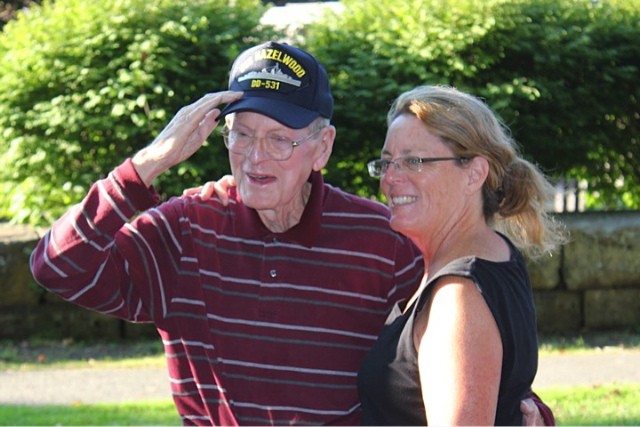
Creighton Lilly graduated from Beaver High School in Bluefield, West Virginia where he was captain of the football team, and then from the United States Naval Academy at Annapolis where he was commissioned as an ensign in the United States Navy in 1945. As a young lieutenant he was appointed Commanding Officer of the newly constructed minesweeper, USS Fidelity (MSO 443). Later, he commanded the destroyer USS Hazelwood (DD 531) on blockade duty during the Cuban Missile Crisis in 1961. Then Creighton commanded Destroyer Division 601, and Destroyer Squadron 35. Creighton made four deployments to Vietnam during the war serving as a Task Force commander in the Seventh Fleet.

While serving in the Pentagon Creighton managed the program that resulted in the re-commissioning of the battleship New Jersey for service in the Vietnam War. For his distinguished military service, Creighton received the revered Legion of Merit, the Bronze Star with Combat V (twice), and more than a dozen other decoration and distinctive campaign medals.

Creighton was both a competent scholar and a teacher. He received his MS degree in International Affairs from George Washington University, and his MBA from Pepperdine University. Creighton was both a remarkable teacher and skilled trainer; first at the U. S. Naval Academy where he taught mechanical engineering, and later at the Naval War College in Newport, Rhode Island. As Chief of Staff of the Pacific Training Command in San Diego, he supervised all of the Navy’s training facilities throughout the Pacific Command. One of Creighton’s heroes, John Paul Jones, described the ideal naval officer as “the soul of tact, patience, justice, firmness, kindness, and charity”. These same words were echoed by the officers and sailors who served under Creighton’s leadership.

Creighton was a faithful member of the Episcopal Church. Creighton and his wife Barbara Anne participated in, and were leaders in the Cursillo church renewal movement in the Episcopal Diocese of San Diego. Creighton was active in the Angel Tree Project, a Christmas gift ministry for the children of parents in prison in San Diego. He was also an active fundraiser for Camp Stevens, the diocesan church camp in Julian, California. Creighton served as Junior and Senior Warden on the Vestry of St. James by-the Sea in San Diego. Creighton also combined his love of sports with his faith during his management of The St. James Sword’s softball team. Later he served as Junior and Senior Warden on the Vestry of Christ Episcopal Church in Bluefield, West Virginia.

If you knew Creighton, then you knew that he had a great passion for the game of golf. Beginning as a caddy at the age of twelve, he played regularly until he was 90. In addition to placing a hole in one, Creighton also won the “longest putt” contest in a golf tournament at the age of 89. Everyone who played golf with Creighton has great stories about the “free advice” he offered to his friends and family while playing golf.


New Diocesan Coordinator for Episcopal Relief & Development

monkimageMy husband, the Rev. DeLaney W. Armstead, deacon and now retired, was the Episcopal Relief & Development representative for Christ Church, Las Vegas. There I assisted him in promoting the work of Episcopal Relief & Development. I was a member of the national standing committee on world mission at that time, and while assisting him, I realized that one vision was not too far removed from the other.

Traveling to third-world countries as a member of world mission helped to visualize my personal efforts in supporting our Christian mandate to feed the hungry, care for the sick, and welcome the stranger. There are many other factors that drew me to Episcopal Relief & Development. One in particular is working closely with the Most Rev. Katharine Jefferts Schori, then bishop of Nevada. I served as secretary to convention for six years in the Diocese of Nevada.

My first year of work in the Diocese of San Diego will be as follows:

  • Manage the online objectives for Episcopal Relief & Development
  • Develop and implement a workflow process
  • Retrieve a list of Episcopal Relief & Development congregational representatives and contacts from the diocesan office
  • Retrieve a list of clergy contacts from the diocesan office
  • Send a letter/email of introduction to diocesan clergy with introductory information about me and a word of thanks to their Episcopal Relief & Development representatives, if they have one and if they do not, requesting that they consider appointing one.

After one month I will follow up with clergy members who have not yet responded, as it is our desire and expectation that all congregations in our diocese will participate.

Once identified, both the new representatives and the already established representatives will receive the following information:

  • Church mailings from Episcopal Relief & Development
  • Email updates from me, the diocesan coordinator, and forwards from the Episcopal Relief & Development network director
  • Notice of congregational representative training sessions at Diocesan Convention

Once the representatives are appointed, I will maintain ongoing dialogue with them. I will encourage them to visit the Episcopal Relief & Development website monthly to familiarize themselves with the ongoing work they do throughout the country and the world.

Episcopal Relief & Development empowers local churches in nearly 40 countries reaching over three million people each year. Congregations should know this, and they should know that Episcopal Relief & Development does not just handle disasters that occur in foreign countries. Many disasters happen here at home. What if there was a fire in your church? A major earthquake in your area? A flood in your community? A mass shooting? A pandemic flu? Congregational representatives will have the opportunity to host meetings about how Episcopal Relief & Development addresses these types of disasters in faith communities.

My main responsibilities in this role are: promoting, recruiting, ministry, communicating, creativity and traveling.

Promoting – As the diocesan coordinator, my ministry is to educate and encourage – a creative ministry. I have the opportunity to encourage members of the diocese to contribute to Episcopal Relief & Development become a part of a network of caring individuals who make a difference in this hurting world.

Recruiting – Every congregation should have an Episcopal Relief & Development contact person, known as the representative, who is elected or appointed by his/her congregation. Representatives highlight eh work of Episcopal Relief & Development.

Ministry – I must be fully informed about Episcopal Relief & Development and its work, submit a quarterly activity report, ensure that Episcopalians in the diocese are aware of Episcopal Relief & Development work, visit as many congregations in the course of a year as possible, thank supporters in the diocese, participate in diocesan convention and be creative in accomplish all of this.

Communicating – I will make information available to congregations about how Episcopal Relief & Development can be an asset to them. This is best accomplished through a workflow that includes the Episcopal Church, me, clergy members, congregational representatives and congregations.

Creativity – I must draw upon all my creativity to think of ways to share the Episcopal Relief & Development message.

Traveling – Another important responsibility of the diocesan coordinator is to attend General Convention wherever it is held. I served as a deputy for four consecutive trienniums, and I served on dispatch of business for three of those years. I traveled to the Philippines from 2001 to 2005 and was part of a work group that assisted the Episcopal Church there in gaining financial autonomy. I plan to use my out-of-the country experience and my Episcopal Relief & Development knowledge to be a speaker at General Convention, using the Diocese of San Diego as an Episcopal Relief & Development role model.

While engaging in mission work for a nonprofit in Machakos, Kenya, I met Monica, a student in the Muindi Mbingu Secondary School. She heard that American missionaries were coming to their remote village to provide a limited number of students with scholarships. The recipients had to commit to living and teaching needed courses in Kenya for five years after graduating from a college in Africa.

Monica walked alone 20 miles from her village to find the Americans. She found the location, but all twelve scholarships had been awarded to other qualified students. The look of horror in her eyes when she knew she was not receiving the scholarship moved me to tears. Later I discovered that without the scholarship money, she was to be sold to an elder for a cow. I offered to pay her tuition, while still paying tuition for my two daughters, and she accepted.

On the flight home, I was concerned as to how I would pay three college tuitions, but as I slept, I felt the presence of God and I knew I could do it. I am proud to say that in 2010 Monica graduated with honors and is now teaching and training children and adults in Kenya. Her major accomplishments include training the male elders in Nairobi that they do not have to sell their very young daughters for cows, a precious commodity in Kenya. Making eye contact with Monica was truly a God thing.

In my work and volunteer work, a few glass ceilings were broken. In the Diocese of California, a diocese more than 150 years old, I was the first African-American female to hold the position of president of the standing committee. I was the first African-American to be elected as General Convention deputy for the Diocese of Nevada. At Christ Church, Las Vegas I was the clerk of the vestry for 10 consecutive years. I was the founder and president of the Nevada chapter of the Union of Black Episcopalians (UBE), a confederation of more than 54 chapters and interest groups throughout the continental US and the Caribbean. We recruited the Most Rev. Katharine Jefferts Schori to be a member during her episcopate in Nevada. The Most Rev. Michael Curry, presiding bishop, is also a member of UBE. I was also the board president for St. Augustine’s Child Care Center.

Every aspect of my career will assist me in building a strong Episcopal Relief & Development organization in the Diocese of San Diego. My 44 years working in corporate American taught me more than my formal education at Rutgers University in New Jersey and Pursue University in Indiana. My husband, the Rev. DeLaney W. Armstead, is a retired deacon. I have two daughters: Dr. Wendy E. Roberts and Beverly Roberts Charles, JD. We became members of St. Margaret’s, Palm Desert after moving from Henderson, Nevada in January 2015. Prior to moving to Rancho Mirage, we were members of Christ Church, Las Vegas, the oldest and largest Episcopal church in Nevada. When visiting Las Vegas, I encourage everyone to go to the cathedral-like church and hear the music coming from the only Shantz organ in Nevada.