Leadership Academy 2026: What Might God Be Forming in You?
Over the years, I’ve had countless times where I’m sitting at my desk, after a long day, looking at a half-finished project and realizing I wasn’t stuck because I didn’t care–I was stuck because I didn’t have the right tools. The ideas were there. The desire was there. The work mattered, but translating that into something clear, something that could actually connect with people and move a ministry forward was hard. Not impossible, just…hard.
I’ve come to see that equipping myself with new tools and new ideas is part of caring for a ministry. Not knowing everything is not a gap in leadership; it is an invitation to expand. An invitation to learn, to grow, and to keep developing the skills that help bring what we care about to life.
Leadership Academy 2026 is designed for exactly that moment.
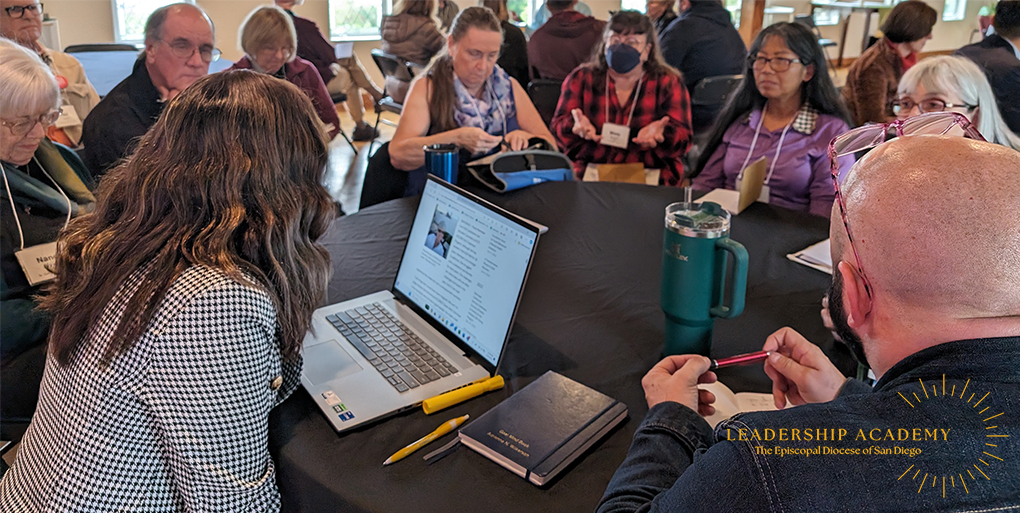
On April 25, leaders from across the Episcopal Diocese of San Diego will gather at Good Samaritan Episcopal Church (4321 Eastgate Mall, San Diego, CA 92121) for a day of learning, reflection, and practical skill-building. It’s a day for anyone who has felt that quiet tension between what they hope for their church or ministry and what they currently know how to do.
What I’ve come to appreciate is that this tension is not something to avoid. It’s where real ministry begins.
In scripture, we see this pattern over and over again. God does not wait for people to feel fully prepared before calling them. Instead, God meets them in the middle of uncertainty and forms them along the way. Moses learns to speak. Peter learns to lead. The disciples learn, very slowly, how to carry the story forward.
Paul writes in Ephesians that the work of leadership is “to equip the saints for the work of ministry.” (Ephesians 4:11-12) That word– “equip”–matters. Ministry and leadership in the church are not about having everything figured out. It’s about continually being formed, so that we can help others as they strive to know Jesus better.
That is the heart of Leadership Academy.
What I value most about a day like this isn’t just the content; it’s what it creates space for. It creates space to step back from the urgency of weekly ministry and invest in the work beneath the work. The kind of work that shapes how we communicate, how we welcome, how we form community, and how we lead. It’s a chance to pick up tools that make the work more sustainable, more intentional, and ultimately more life-giving.
It also creates space to remember that we are not doing this alone. Across the diocese, there are people asking the same questions, carrying the same responsibilities, and holding the same hope for their community. Every year, when we gather at Leadership Academy, something shifts. Ideas get shared. Language becomes clearer. What sometimes feels isolating begins to feel shared.
That kind of gathering is not just practical. It’s deeply theological. The Church has always been a learning community. From the earliest disciples to now, we have been shaped in relationship with God and with one another. We listen, we practice, we try, we fail, and we grow. Leadership Academy is one more expression of that ongoing formation. And in this Year of Evangelism, it takes on a deeper sense of purpose.
Because evangelism is not one track among many–it’s the thread that runs through all of it. It shows up in how we tell the story, how we form disciples, and how we build the foundations that make ministry sustainable. Evangelism is not just about what we say; it’s about who we are becoming as a Church.
The Evangelism Track helps us name and practice invitation.
The Discipleship track shapes us into people who have something real to share.
The Foundations track gives us the structure to support that work over time.
Together, they form a fuller picture of what it means to be a Church that is alive, growing, and connected to the world around it.
Because evangelism is not about having the perfect words or a polished strategy. It’s about being formed into people who can recognize where God is already at work and have the courage to join in. It’s about learning how to invite, how to listen, and how to make space for others to encounter something real.
And those are learned skills. They are practiced over time, in community, with intention.
If I go back to that moment—sitting at my desk, looking at something unfinished—I’ve learned that the way forward is rarely to push harder on my own. It’s to step into a space where I can say, “Who can I ask for help? Where can I learn to do this in a new way? How can I gain perspective and be reminded that growth is part of the calling?” Leadership Academy is one of those spaces.
So if you’ve felt the tension between what you hope to create and what you currently know how to do, I encourage you to come.
Not because you need to have it all figured out, but because you don’t. And that’s exactly where formation begins. Register. Show up. Be part of the day. Because the work you are doing matters. And investing in how you do that work, together, is one of the most faithful things we can do.